
Choosing your DIY equipment starts with identifying the type of work to be done before looking at a catalog. A tool suited to the task reduces the time spent, limits rework, and decreases the risk of injury. The selection logic is based on three axes: the nature of the material being worked on, the expected frequency of use, and the compatibility between different devices.
Battery Compatibility: The Criterion That Unit Price Masks
Most DIYers buy their tools one by one, as needed. Drill one day, jigsaw the next month, sander later. The common reflex is to compare unit prices without checking if the batteries are interchangeable from one device to another within the same brand.
A battery compatible with the entire range avoids multiplying chargers and batteries. Before purchasing your first cordless tool, check that the manufacturer offers a coherent ecosystem where the same battery powers the drill, screwdriver, grinder, and work light. The initial extra cost of a slightly more expensive brand pays off as soon as you buy the second or third tool.
Note: The European regulation on batteries (regulation (EU) 2023/1542, published on July 28, 2023) provides, starting from February 18, 2027, for withdrawal and replacement requirements for certain portable batteries. This rule targets manufacturers and does not guarantee that an existing tool will be compatible with a battery from another brand. It is therefore better to secure compatibility from the start rather than hoping for future regulatory interoperability.
To compare ranges and their battery platforms, consulting the equipment on Bricotronique allows you to quickly visualize which tools share the same power system.
Construction Dust and Choosing DIY Tools
Sanding a wall, drilling concrete, or cutting wood generates fine particles. The INRS documents the risks associated with crystalline silica dust when working with mineral materials. This parameter should be part of the tool selection process just like power or price.
Specifically, check two points before purchasing a sander or circular saw:
- The possibility of connecting a dust extraction system: an integrated dust extraction nozzle or an adapter for a construction vacuum significantly reduces the amount of dust suspended in the room.
- Compatibility with a mask suitable for the material: sanding plaster does not require the same filtration as working with stone or tiles. A minimum FFP2 mask is recommended for fine mineral dust.
- The bulk of the dust extraction system: some models include a small collection bin, while others require a separate vacuum. Depending on the space available in your workshop, this detail changes the user experience.
Too many guides limit themselves to mentioning safety glasses. Managing dust upstream, by choosing a tool equipped for it, is more effective than just wearing a mask afterward.
Drill, Screwdriver, Hammer Drill: Knowing How to Distinguish Drilling Tools
The most common confusion among DIYers concerns the family of drilling tools. A cordless drill/driver, a percussion drill, and a hammer drill do not serve the same function, and using one instead of the other can damage the material or the tool.
Cordless Drill/Driver
It drills wood, plastic, and thin metals, and screws or unscrews. It is the default versatile tool for everyday DIY: assembling furniture, fixing shelves in drywall, assembling battens. Adjustable speed is the criterion to check first: screwing requires a slow speed, while drilling metal requires a fast speed.
Percussion Drill
It adds a hammering motion to the rotation, allowing it to drill through brick and concrete blocks. For walls made of hollow materials or light masonry, it is sufficient. It does not replace a hammer drill on reinforced concrete.
Hammer Drill
Reserved for hard materials (solid concrete, stone), it combines rotation and hammering with significantly more energy. Its weight and price make it suitable for DIYers who regularly work on heavy construction. For occasional use, renting remains a relevant option.

Hand Tools and Measurement: The Often-Neglected Foundation
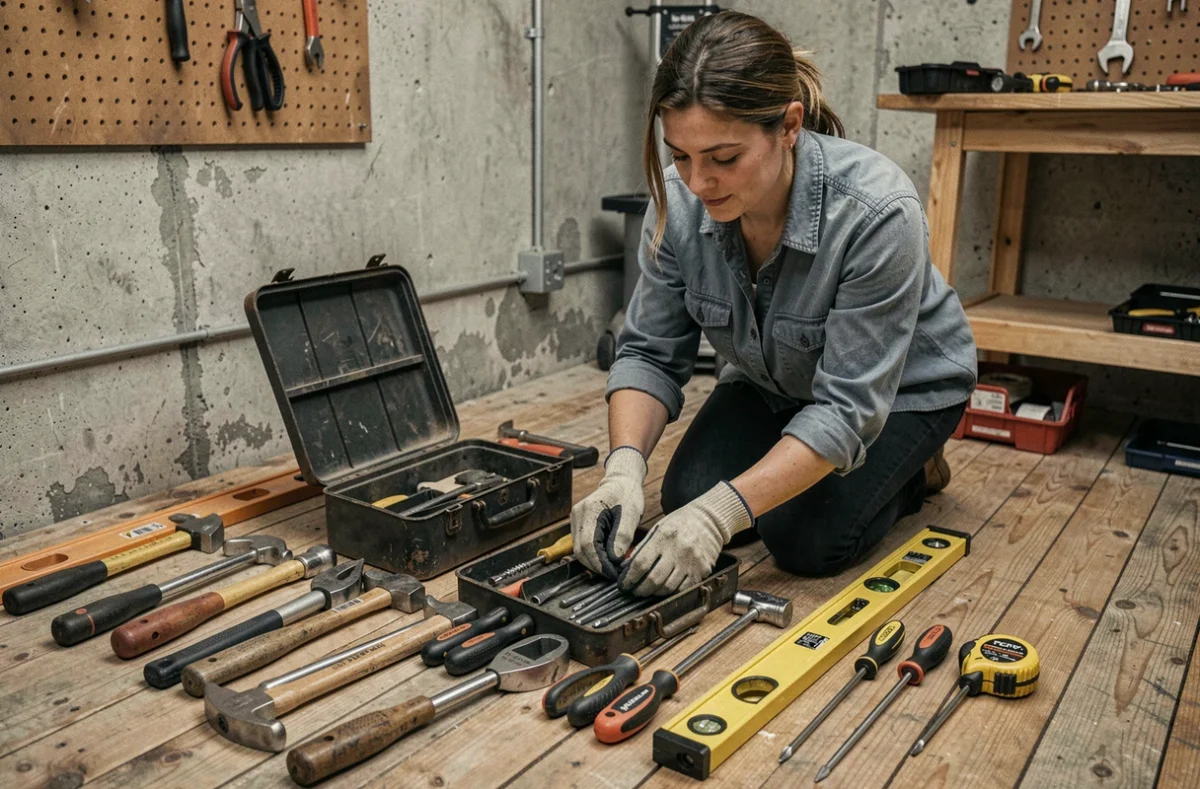
Before plugging anything in, the quality of hand tools determines the precision of the work. A set of screwdrivers with tips that slip in the screw damages the head and makes future disassembly difficult. A well-sized screwdriver transmits force without slipping.
For measurement, a good quality tape measure (reliable locking, rigid tape on the first meter) avoids cutting errors. A small spirit level completes the equipment for any shelf, frame, or wall-mounted furniture installation.
Pliers also deserve attention. A quality adjustable wrench serves in plumbing, electricity, and light mechanics. Prefer a model with machined jaws (not just stamped): the grip on nuts and fittings is incomparable.
Hand Saw or Electric Saw: Adapting the Tool to the Material and Volume
To cut a board or batten occasionally, a well-sharpened hand saw is sufficient. The electric saw is justified as soon as the cutting volume increases or when the material requires prolonged effort.
The jigsaw is the most versatile electric cutting tool for a DIYer: it cuts wood, laminate, and, with the right blade, thin metal or PVC. The circular saw, more powerful, is aimed at those who frequently make straight cuts in panels or solid wood.
Regardless of the type of saw, the blade does as much work as the motor. An unsuitable blade (too few teeth for laminate, too many teeth for softwood) produces splinters, heats up, and prematurely wears out the tool. Keeping two or three spare blades suitable for common materials in your workshop prevents interruptions in a project.
Choosing DIY equipment is not just about ticking off a list of tools. The consistency between devices, managing dust-related risks, and distinguishing between similar but different tools makes the difference between a useful purchase and a drawer full of underutilized equipment. Starting from the project rather than the aisle remains the most reliable method for sustainably equipping your workshop.